100 Taiwan firms tell 10000 employees to go on unpaid leave AsiaOne As Taiwan relies heavily on the export market, the flooding in Thailand and European debt crisis have all negatively impacted the local economy, Wang said, adding that the council has been monitoring events and are ahead of the curve for the ...
Two things that are very different from each other.
Origin
We have hundreds of phrases to indicate the similarity of one thing with another andsimileslike 'as alike as two peas in a pod' are commonplace in everyday speech. However, as far as I know, there is only one phrase that does the opposite and explicitly refers to the difference between things and that is 'as different as chalk and cheese'. This is an old expression and the earliest citation of it is in John Gower's Middle English textConfessio Amantis, 1390:
Lo, how they feignen chalk for chese.
Tourist boards in several of the chalkland areas of the UK try to place the phrase's origin in their locality and allude to vague connections between chalk and the local cheese. None of these are convincing and they clearly owe more to marketing than to etymology. So, how did the phrase come about?
There must have been a time in the development of English when we had no standard phrase to express the idea that two things were 'as different as X and Y'. When someone coined such a phrase, and that someone may well have been Gower in 1390, clearly he needed candidates for the roles of X and Y. That doesn't sound difficult, after all most things are different from most other things.
"Maybe, 'as different as a cormorant and a lamp-post'", thinks our coiner, "or 'as different as floorboards and greengrocers'". "No, 'as different as chalk and cheese' sounds better". Why? For no better reason that the fact the 'chalk' and 'cheese' are short and snappy words that alliterate. The English language is packed full of phrases that contain pairs of rhyming or alliterating words - often just because the person who coined them liked the sound of them; for example, hocus-pocus, the bee's knees, riff-raff etc.
A modern-day spin-off of 'chalk and cheese' is 'chalk and talk'. This refers to the traditional teaching method where the teacher stood at the front to address the class while writing on the blackboard with a stick of chalk (which those of a certain age will well remember). The phrase emerged in the UK in the 1930s but had a shortish run as a widely used expression as classrooms began to be equipped with whiteboards in the 1960s. 'Dry-wipe marker pen and talk' never caught on.
Fukushima radiation 47 times higher than combined 45 prefectures
December 15, 2011
The level of cesium fallout in Fukushima Prefecture in the four months after the March 11 disaster at the nuclear power plant there has been assessed at 6.83 million becquerels per square meter.
The science ministry announced its finding Dec. 14.
It released similar data for 45 prefectures last month, but not on Fukushima and Miyagi prefectures.
Fukushima’s concentration of radioactive material is 168 times the 40,801 becquerels recorded by Ibaraki Prefecture, which had the highest level among the 45 prefectures.
Fukushima’s 6.83 million figure is 47 times the 144,446 becquerels recorded for all the 45 prefectures.
The figures of accumulated radioactive substances for the March-June period were calculated on the basis of cesium-134 and cesium-137 measurements in dust gathering in containers at health research institutes and other facilities in different locations.
The assessment project for Fukushima Prefecture had been hindered by the Great East Japan Earthquake. The measurement site for the prefecture is Okuma, where the Fukushima plant is located. Ninety-four percent of the 6,836,050 becquerels was concentrated in March, an indication of the severity of radiation spreading shortly after the onset of the accident.


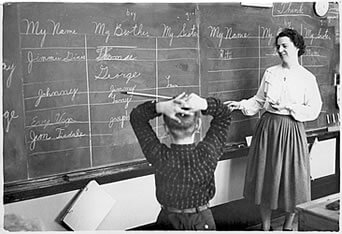 A modern-day spin-off of 'chalk and cheese' is 'chalk and talk'. This refers to the traditional teaching method where the teacher stood at the front to address the class while writing on the blackboard with a stick of chalk (which those of a certain age will well remember). The phrase emerged in the UK in the 1930s but had a shortish run as a widely used expression as classrooms began to be equipped with whiteboards in the 1960s. 'Dry-wipe marker pen and talk' never caught on.